Introduction
Crystal awards are dense, rigid, and visually unforgiving. A carton can arrive without obvious external damage while the award inside has a chipped bevel, scratched face, separated base, or crushed presentation box. Procurement managers therefore need packaging designed as a system: product protection, insert, individual box, master carton, pallet or parcel configuration, and logistics route.
“Export standard packaging” is not a measurable requirement. Buyers should define expected hazards, pack-out, material specifications, carton limits, and validation. The objective is not maximum packaging; it is sufficient, repeatable protection with acceptable cube, weight, presentation, and waste.
Map the Distribution Environment First
Packaging design begins with the route. A palletized ocean shipment to a distributor faces different handling from individual e-commerce parcels. Record product weight, dimensions, protrusions, center of gravity, bonded joints, decoration vulnerability, units per carton, stacking period, expected transloading, climate exposure, and final-mile method.
Ningbo and Shanghai are nearby common ports for Small-Bridge Crystal, but the full route may include truck transfer, container handling, destination deconsolidation, warehouse stacking, and parcel delivery. Each transfer adds shock, vibration, compression, puncture, abrasion, or moisture exposure.
Identify Product Failure Modes
Review prototypes and prior damage by location. High-risk areas include corners, thin peaks, beveled edges, bonded bases, metal attachments, and decorated faces. Heavy awards can compress soft inserts or build momentum inside an oversized cavity. A snug fit is useful only if it avoids concentrated stress and allows practical packing tolerances.
Build Protection in Layers
The first layer prevents surface abrasion and contamination. Use a clean, non-scratching wrap, sleeve, or bag compatible with the decoration. Avoid material that transfers ink, traps abrasive particles, or bonds to printed surfaces under heat.
The insert should immobilize the award and spread loads onto robust areas. It should protect every vulnerable edge from the box wall and separate accessories. Its density, thickness, cavity dimensions, and recovery behavior must be specified—not replaced with “foam” as a generic term. A retention check can confirm the product stays seated during handling.
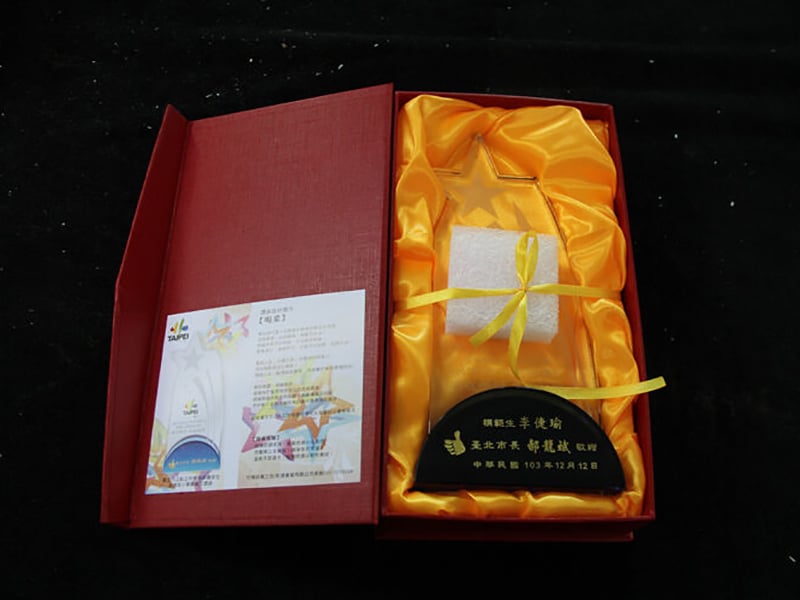
The individual gift box controls presentation and contributes structure, but it should not be assumed to be the sole shipping container. The master carton consolidates units, carries shipping marks, and resists compression. Control board grade or performance specification, internal dimensions, closure method, gross-weight limit, unit orientation, and count.
| Packaging layer | Primary function | Buyer specification | Validation question |
| Surface wrap | Prevent scratches/soil | Material, closure, print compatibility | Any abrasion or transfer? |
| Insert | Immobilize and cushion | Material, density, dimensions, contact zones | Does product shift or bottom out? |
| Gift box | Presentation and containment | Construction, fit, finish | Does it remain saleable? |
| Master carton | Consolidation/compression | Board/performance, count, gross weight | Does it retain integrity? |
| Pallet/parcel system | Unit-load or individual distribution | Pattern, restraint, labels | Is it suitable for the route? |
Use an ISTA-Informed Validation Strategy
The International Safe Transit Association publishes test procedures for packaged products. Buyers can review the official ISTA test-procedure resources and select a suitable protocol with a competent packaging laboratory or specialist. Do not claim “ISTA certified packaging” merely because an informal drop was performed.
A validation sequence may condition packages and expose them to defined drops, vibration, compression, or other hazards relevant to the route. The exact procedure, orientation, level, sample number, and acceptance criteria must be chosen for the distribution system. Testing one lightweight SKU does not automatically validate a heavier or differently shaped family.
Define Pass/Fail Before Testing
Acceptance criteria should cover both product and package. Product failures can include cracks, chips, scratches, joint movement, decoration damage, or loss of stability. Packaging failures can include insert collapse, product migration, gift-box crushing, carton rupture, unreadable labels, or loss of protective clearance.
Document the configuration with component specifications, photographs, packed weight, dimensions, sealing pattern, and revision. If any component or pack count changes, review whether revalidation is required. A successful laboratory configuration is useful only when production pack-out matches it.
Control Production Pack-Out
Create a visual packing instruction at the workstation. Show wrap orientation, insert sequence, accessory position, box direction, carton pattern, void-fill amount if any, and closure. Conduct first-pack approval and periodic audits. Weigh packed cartons or use count reconciliation to detect missing components.
Incoming quality control should verify packaging materials against approved specifications. Final quality control should inspect box appearance, insert fit, product cleanliness, barcode and shipping-mark accuracy, carton closure, count, and gross weight. Small-Bridge Crystal offers custom packaging with an indicated MOQ of 30 units, but construction, print, validation scope, and availability should be confirmed for each order.
Pilot shipments can provide field evidence, especially when the route is new. Record damage by SKU, carton, location, failure mode, carrier stage, and photographs. A simple damage percentage alone cannot distinguish a weak insert from poor carton compression or exceptional mishandling.
Balance Damage Risk, Cube, and Sustainability
More material is not automatically safer. Excess void space increases movement; overly rigid contact can transfer shock; oversized cartons raise freight cube and may reduce pallet stability. Packaging optimization should compare protection, packed volume, gross weight, packing labor, recyclability, and destination disposal requirements.
Request material identification and minimize mixed materials where feasible without compromising protection. Validate any lighter or fiber-based redesign rather than treating sustainability claims as proof of performance. Consider container humidity and storage duration when choosing cartons, inserts, bags, and desiccant strategy; any desiccant use and labeling should follow applicable requirements.
Risk and Compliance Controls
Packaging errors can create product-safety, worker-handling, environmental-labeling, and customs risks. Confirm gross-weight limits, handling marks, barcode data, country-of-origin marking requirements, and packaging-material restrictions for the destination. Wood pallets or wood packaging may trigger specific phytosanitary requirements; use qualified logistics advice for the actual route.
Do not let a passed packaging test conceal an uncontrolled production change. Maintain approved component samples or specifications, supplier identities, revision records, test reports, and pack-out audit results. Regulatory marks on a carton must be supported and applicable; they are not decorative graphics.
Conclusion & Next Step
Reliable crystal award export packaging starts with route hazards and failure modes, then integrates surface protection, engineered retention, presentation packaging, master cartons, validation, and pack-out control. This evidence-based approach reduces breakage without blindly increasing materials or freight cube.
Next step: Send product dimensions, weight, quantity, destination, shipping mode, gift-box needs, and distribution route through Small-Bridge Crystal’s contact page to discuss a packaging configuration and validation plan.
Suggested internal links:
• From Design to Delivery: The Making of a Stunning Crystal Trophy
• Key Elements of High-Quality Crystal Craft
• Contact Small-Bridge Crystal
 Hot News
2026-09-21
2026-09-20
2026-09-19
2026-09-18
2026-09-17
Copyright © Pujiang Small-Bridge Crystal Handicrafts Co., Ltd. All Rights Reserved - Privacy Policy
 EN
EN